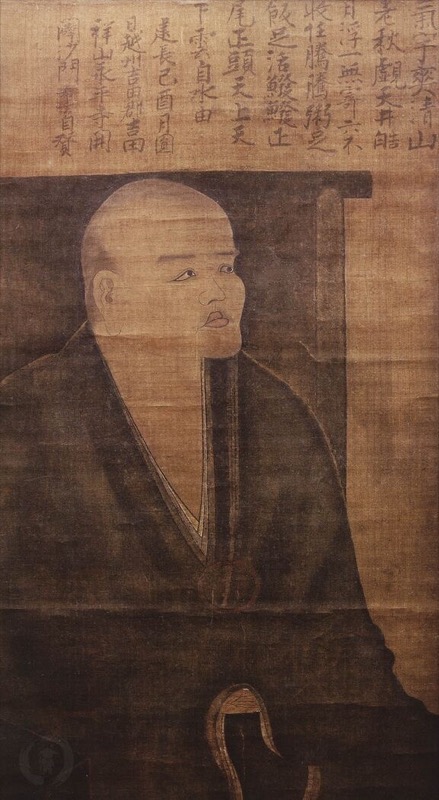
Dōgen was born in Kyoto in 1200 into the aristocracy. According to Eiheiji, his mother died when he was eight, and the sight of incense smoke at her funeral turned his mind to the impermanence of life. In his early teens he became a monk on Mount Hiei, the centre of the Tendai school.
Dissatisfied with the answers he found there, he went to China in 1223 with the monk Myōzen. After visiting several monasteries he met the teacher Rujing (Nyojō in Japanese) on Mount Tiantong, where practice centred on zazen. Eiheiji records that Dōgen awakened when Rujing spoke of “dropping off body and mind”, and that he then received from Rujing the Dharma transmitted from Shakyamuni Buddha. Sotoshu, the Soto school, counts Dōgen as its founder.
He returned to Japan in 1227 with, as Sotoshu puts it, no pile of sutras but the practice of just sitting, shikantaza. He wrote the Fukanzazengi to explain how to practise zazen, and the Bendōwa to say why. He founded Kōshōji, his first monastery, at Fukakusa near Kyoto. In 1243 he accepted an invitation from his lay supporter Hatano Yoshishige and moved to Echizen, now Fukui Prefecture. There he established Daibutsuji in 1244, renamed Eiheiji two years later. Eiheiji is still a working monastery.
His major work is the Shōbōgenzō, “Treasury of the True Dharma Eye”. The first fascicle, Bendōwa, dates from 1231, and the collection was compiled as a ninety-five fascicle edition in 1690. Among its chapters is the Genjōkōan. He also wrote the Tenzo Kyōkun, instructions for the monastery cook. Eiheiji tells how, in China, an elderly monastery cook told him that practice is “just in front of you”. Eiheiji teaches that sitting zazen and daily work such as eating, walking and cleaning are the same practice, not a means to some later goal.
In 1253 his health failed. He went to Kyoto for treatment and died there at the age of 53.
Shunryu Suzuki Roshi belonged to the Soto school Dōgen founded in Japan. The link is lineage, not a teacher and student relationship.
Soto Zen’s own site publishes an English translation of the Shōbōgenzō.
Read more
Books
Shōbōgenzō (Treasury of the True Dharma Eye), English translation online ↗
Fukanzazengi (Universally Recommended Instructions for Zazen)
Bendōwa (An Account of Discerning the Way)
Tenzo Kyōkun (Instructions for the Cook)
Sources and verification
4
Written from published sources by the volunteer editors. Not yet reviewed by an outside advisor.
- OrganisationEiheiji: The Story of Dōgen Zenji (birth in Kyoto 1200, China 1223, Rujing, return 1227, Kōshōji, Echizen 1243, Eiheiji, death at 53)
- OrganisationSoto Zen Buddhism (Sotoshu): Dogen Zenji (Hiei, China, shikantaza, Fukan Zazengi, Bendowa, Shobogenzo, Eiheiji)
- OrganisationSoto Zen Buddhism (Sotoshu): Shōbōgenzō (first fascicle Bendōwa 1231; ninety-five fascicle edition)
- ScholarlySteven Heine, Dōgen: His Life, Religion, and Poetry, Education About Asia (1200 to 1253, China 1223 to 1227, Eiheiji in the 1240s)
Painting: Dōgen watching the moon, Hōkyōji, Fukui Prefecture, c. 1250, artist unknown (Wikimedia Commons, public domain)
Something wrong, missing or out of date? Report a problem. A source we can check makes it quicker to fix.