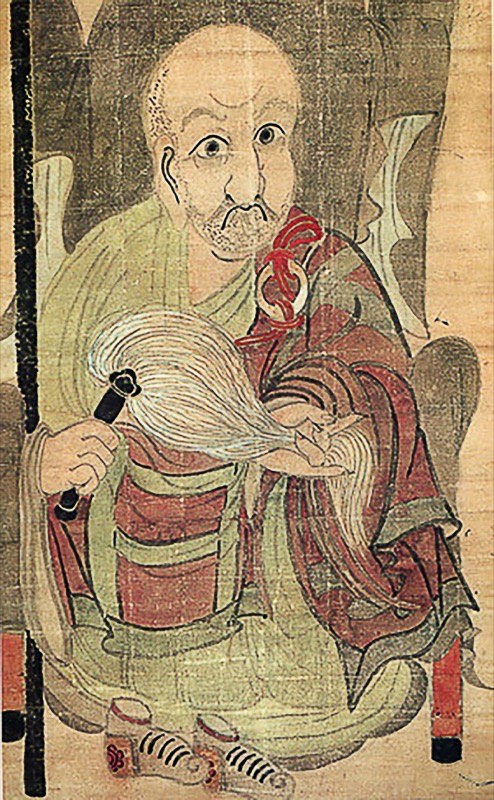
Hakuin Ekaku (1686 to 1769) lived almost his whole life in Hara, a village near Mount Fuji in eastern Japan. He entered the monastic life as a teenager at the local temple, Shōin-ji, then travelled to study with Zen teachers. In 1716 he came back to Shōin-ji, which had fallen into near-ruin in his absence, and it remained his base until he died.
He is credited with reviving the Rinzai school, which was struggling when he came to it. He focused training back on seated meditation and koan study, and Britannica credits him with the paradox of contemplating the sound of one hand clapping. Modern Rinzai teachers trace their lineage back through him. He lived in poverty among his farming parishioners and taught that a moral life must go with religious practice.
We know his story largely from his own writings and from a biography by his student Torei Enji. In them, the turning point comes in 1726, when he was in his early forties. While reading a passage of the Lotus Sutra about a bodhisattva practising beyond awakening until all beings are saved, he reached a decisive awakening. From then on, the accounts say, he gave his life to teaching others. Monks, nuns and lay people travelled to a once-obscure temple to hear him.
He left more than fifty written works, mostly built on talks. Among them are Orategama (“The Embossed Tea Kettle”) and Yasen kanwa (“A Chat on a Boat in the Evening”), two works of practical advice, and Keisō dokozui, written for advanced students. His autobiography, Wild Ivy, and his letters in Beating the Cloth Drum are available in English through Norman Waddell’s translations. Only part of his output has been translated.
Hakuin was also a calligrapher and ink painter, using bold brushwork to put his teaching into images. The portrait on this page is a self-portrait from 1767.
Read more
Books
Wild Ivy: The Spiritual Autobiography of Zen Master Hakuin
trans. Norman Waddell · Shambhala Publications
The Essential Teachings of Zen Master Hakuin
trans. Norman Waddell · Shambhala Publications
Beating the Cloth Drum: Letters of Zen Master Hakuin
trans. Norman Waddell · Shambhala Publications
The Zen Master Hakuin: Selected Writings
trans. Philip B. Yampolsky · Columbia University Press · 1971
Online
Sources and verification
3
Written from published sources by the volunteer editors. Not yet reviewed by an outside advisor.
- ReferenceEncyclopaedia Britannica: Hakuin (born 19 January 1686 and died 18 January 1769 in Hara; joined Rinzai about 1700; returned to Shōin-ji in 1716; koan use; list of chief writings; artist and calligrapher)
- BookShambhala Publications: Hakuin Ekaku, A Reader's Guide (life in Hara and Shōin-ji; final awakening in 1726; students; more than fifty works; Waddell translations; sources for his life in his own writings and Torei's biography)
- ReferenceWikipedia: Hakuin Ekaku (bibliography: Yampolsky, Columbia University Press, 1971; Waddell, Wild Ivy)
Painting: self-portrait by Hakuin Ekaku, 1767 (Wikimedia Commons, public domain)
Something wrong, missing or out of date? Report a problem. A source we can check makes it quicker to fix.