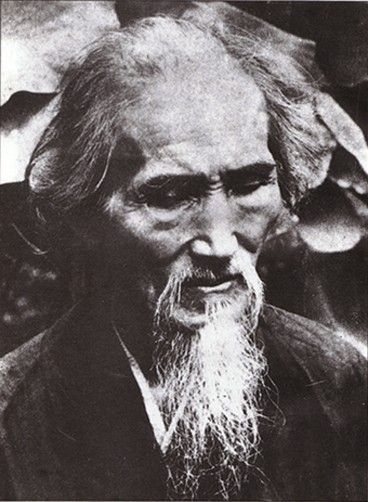
Master Hsu Yun (Xuyun, “Empty Cloud”) was among the most widely known Chinese Chan teachers of the late 19th and early 20th centuries. His traditional dates, 1840 to 1959, would give him a life of about 120 years. The autobiography’s introduction and later writers repeat that figure, but it cannot be checked against independent records, so treat his ages as traditional.
According to his autobiography, he left home at 19 and became a monk, and he remained one for 101 years. He is known for long pilgrimages on foot. The introduction describes one that began in his 43rd year, when he prostrated every third step on the way to the island of Putuo and then to Mount Wutai, out of gratitude to his parents. It adds that he went on to Tibet and then to India, Ceylon and Burma. He worked with the huatou method of Chan, sustained questioning on a single phrase. In his 56th year, at Gaomin Monastery in Yangzhou, he reached what the account calls his complete enlightenment.
Much of his later life went into rebuilding. The introduction lists the monastery at Caoxi associated with Huineng, the Yunmen Monastery in Guangdong, and Zhenru Monastery on Mount Yunju in Jiangxi. At Zhenru he lived at first in a cowshed. By its account he also revived the teaching of the Five Chan Schools, restored the monastic farming practice of self-sufficiency, and opened temple halls to lay people. He taught Pure Land recitation as well as Chan.
The introduction records that in 1951 to 1952, after the new government took power, he was held and beaten at Yunmen, and that he refused to leave the mainland. He died at Zhenru Monastery on 13 October 1959.
His life is told in Empty Cloud, translated by Charles Luk and later revised by Richard Hunn. The full text is linked below.
Read more
Books
Empty Cloud: The Autobiography of the Chinese Zen Master Xu Yun ↗
trans. Charles Luk (revised and edited by Richard Hunn) · Element Books · 1988
Sources and verification
3
Written from published sources by the volunteer editors. Not yet reviewed by an outside advisor.
- BookXu Yun, Empty Cloud: The Autobiography of the Chinese Zen Master Xu Yun, trans. Charles Luk, rev. and ed. Richard Hunn (Element Books edition), Introduction (death on 13 October 1959 on Mount Yunju; monk for 101 years; temples restored at Caoxi, Yunmen and Zhenru; enlightenment at Gaomin Monastery, Yangzhou; the Yunmen beating of 1951 to 1952; nickname 'Hanshan come again')
- ReferenceBuddhistdoor Global: The Legacy of Ch'an Master Xu Yun (1840-1959) (lived into his 120th year; left home at 19; monk for 101 years; restored temples across China)
- ReferenceWikipedia: Xuyun (infobox marks the 1840 birth date as reputed; used as a pointer only)
Portrait by unknown photographer, before 1959 (Wikimedia Commons, public domain)
Something wrong, missing or out of date? Report a problem. A source we can check makes it quicker to fix.