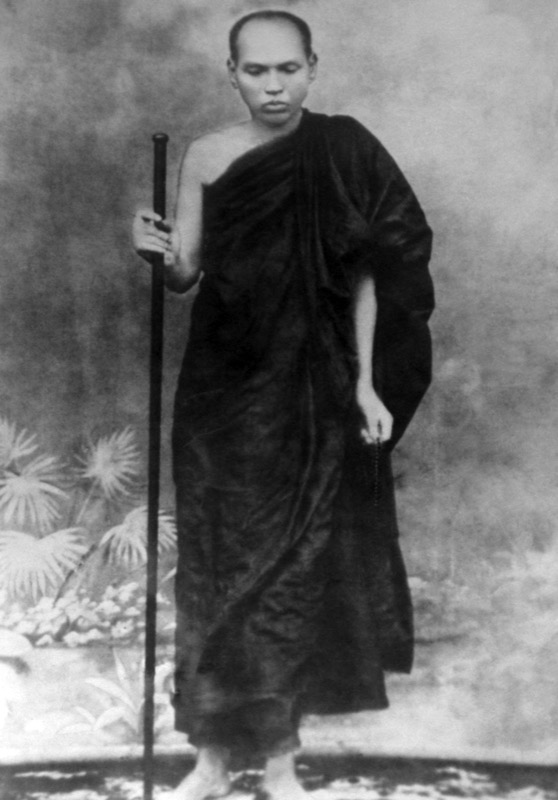
Ledi Sayadaw was born in 1846 in a village in northern Burma and given the name Maung Tet Khaung. He became a novice at fifteen, took the name Nanadhaja, and was ordained a bhikkhu in 1866. The next year he went to Mandalay, then the royal capital and the country’s centre of learning, and studied there for many years. In 1871 he helped edit and translate Abhidhamma texts for the Fifth Buddhist Council.
His reputation first rested on scholarship. The Vipassana Research Institute records that his commentary on a standard Abhidhamma manual, the Paramattha-dipani, appeared in 1897 and corrected points in the older commentary and became the standard reference.
In the 1880s he left Mandalay for the Ledi forest near Monywa, where a monastery grew around him and gave him the name by which he is known. Erik Braun, who has written a study of his life, notes that there is no record of serious meditation during his Mandalay years. Meditation became central to his life after he left. In 1900 he handed over the monastery and spent time in mountain caves beside the Chindwin River.
Two things set him apart. He wrote about the Dhamma in Burmese, aiming, according to the VRI, to be understood by a simple farmer, at a time when such material was not written for lay readers. And he taught meditation to laypeople as well as monks. Braun describes this as the start of the wide lay practice of insight meditation.
The British government of India gave him the title Aggamaha-pandita in 1911. He went blind in old age and spent his last years teaching meditation. He died in 1923 at Pyinmana.
One of his students was a farmer and meditation teacher, U Po Thet, known as Saya Thetgyi. Thetgyi travelled to Monywa to practise with him, and Ledi Sayadaw advised him to develop concentration and wisdom before he began to teach. Thetgyi later taught Sayagyi U Ba Khin, whose student S. N. Goenka founded the ten-day courses held at centres worldwide. The Vipassana Research Institute lists him, after the Buddha, first in its chain of teachers.
Some of his writings are available in English, collected as The Manuals of Dhamma, and one essay on anatta is on Access to Insight.
Read more
Books
The Manuals of Dhamma (collected writings, English translation) ↗
Vipassana Research Institute
Buddhist Publication Society
Sources and verification
5
Written from published sources by the volunteer editors. Not yet reviewed by an outside advisor.
- OrganisationVipassana Research Institute: Ven Ledi Sayadaw (birth, ordination 1866, Mandalay, Fifth Council 1871, Monywa 1882, Ledi forest, Paramattha-dipani 1897, title 1911, blindness, death 1923, U Po Thet as his student, The Manuals of Dhamma)
- OrganisationVipassana Research Institute: Saya Thetgyi 1873-1945 (travelled to Monywa to practise with Ledi Sayadaw; advised by him to develop concentration and wisdom before teaching)
- BookLion's Roar: The Insight Revolution, Erik Braun (born 1846, Mandalay years, 1883 fire, Ledi forest monastery, 1900 retreat to caves, insight meditation made accessible to laypeople)
- ArchiveAccess to Insight: Ledi Sayadaw (English works, The Advantages of Realizing the Doctrine of Anatta)
- Organisationdhamma.org: The Chain of Teachers, Sayagyi U Ba Khin (Saya Thetgyi as U Ba Khin's teacher)
Portrait by unknown photographer (Wikimedia Commons, public domain)
Something wrong, missing or out of date? Report a problem. A source we can check makes it quicker to fix.