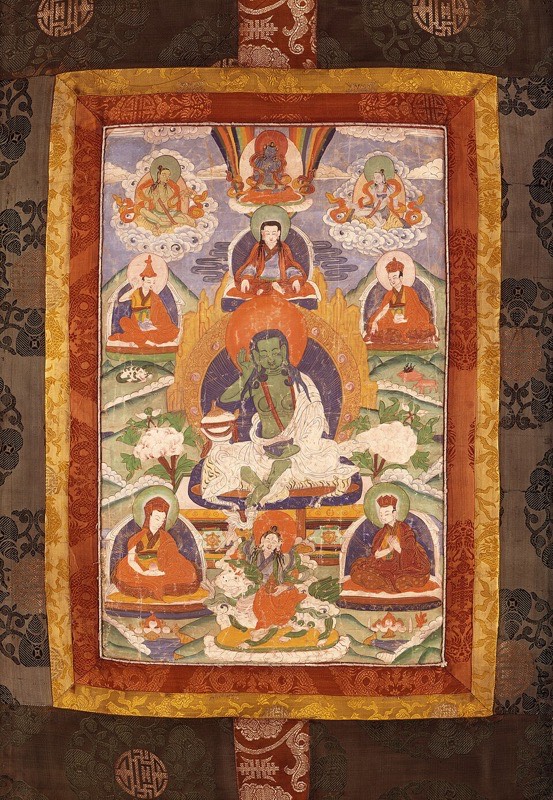
Milarepa lived in Tibet in the 11th and early 12th centuries. Very little of his life is known with historical certainty. The dates most often given are 1040 to 1123, which modern scholars widely accept, and 1052 to 1135, the dates in his best-known biography; other Tibetan historians place his birth earlier still. Lotsawa House calls him Tibet’s most famous poet-saint, and the Kagyu tradition counts him, with Marpa and Gampopa, among its three central figures.
Nearly everything told about his life comes from The Life of Milarepa by Tsangnyön Heruka (1452 to 1507), written more than three centuries after he died. Read it as the tradition’s account. In it, Milarepa’s father dies when he is a boy, and an uncle and aunt take the family’s wealth. At his mother’s urging he learns black magic, kills thirty-five people at a wedding feast and destroys the village’s harvest with a hailstorm. He comes to regret it and goes looking for a teacher. He finds Marpa the Translator, who refuses to teach him at first and sets him a series of ordeals, including building stone towers, which Marpa later explains were a way of purifying his past deeds. A tower said to be his still stands at Sekhar Gutok Monastery. Marpa then gives him the practices of inner heat (tummo), the aural instructions and mahamudra, and tells him to spend his life meditating in mountain retreat.
He did. His most famous retreat was Drakar Taso, where, the story goes, he lived on nettles until his skin turned green. Dozens of places along Tibet’s southern border are linked to him, and three great pilgrimage sites, Tsari, Labchi and Mount Kailash, are said to have been opened or prophesied by him.
He taught mainly through spontaneous songs of realisation. Tsangnyön Heruka collected them in a companion volume, The Hundred Thousand Songs of Milarepa; Garma C. C. Chang’s English translation appeared in 1962.
His best-known students were Rechungpa and Gampopa. Gampopa helped establish the lineage of Kagyu masters and institutions that continues today.
Andrew Quintman’s English translation of The Life of Milarepa was published by Penguin Classics in 2010.
Read more
Books
The Life of Milarepa (by Tsangnyön Heruka) ↗
trans. Andrew Quintman · Penguin Classics · 2010
Sources and verification
3
Written from published sources by the volunteer editors. Not yet reviewed by an outside advisor.
- ReferenceAndrew Quintman, 'Milarepa', The Treasury of Lives (April 2010): dates and their variants, Tsangnyön Heruka (1452 to 1507) as biographer, the account of his youth, Marpa's trials and the tower at Sekhar Gutok, tummo, the aural instructions and mahamudra, Drakar Taso, Tsari, Labchi and Kailash, the Hundred Thousand Songs, Rechungpa and Gampopa as best-known students; bibliography for the Chang and Quintman translations
- ArchiveLotsawa House: Jetsün Milarepa (1040 to 1123; 'Tibet's most famous poet-saint'; Marpa, Milarepa and Gampopa as 'three central figures of the Kagyü tradition')
- BookPenguin Classics: The Life of Milarepa (publisher's page; UK paperback 5 May 2011)
Painting: Milarepa, thangka, Tibet or Nepal, 19th century, Los Angeles County Museum of Art (Wikimedia Commons, public domain)
Something wrong, missing or out of date? Report a problem. A source we can check makes it quicker to fix.