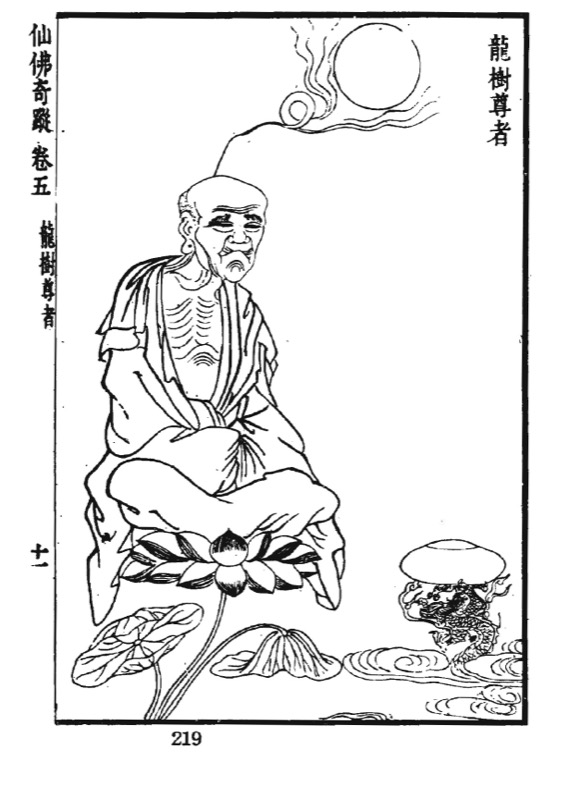
Nāgārjuna was an Indian Buddhist monk and philosopher who lived at some point between about 150 and 250 CE, probably mainly in southern India. Beyond that, scholars say very little can be stated with certainty. Legendary accounts abound, and works by later authors of the same name have been attributed to him.
The Tibetan, Chinese and later traditions fill the gap with stories. Traditional accounts say he was born a Brahmin, entered the Buddhist order after a prediction that he would die young, and studied at Nālandā. Another tradition says he was invited to the realm of the nāgas, serpent beings, where he recovered the Perfection of Wisdom (Prajñāpāramitā) scriptures and returned them to the human world. His name is linked to that story. These are legends told about him, not documented history.
SEP calls his most important work the Mūlamadhyamakakārikā (“Fundamental Verses on the Middle Way”), about 450 stanzas that set out the whole of his thinking. Its central claim is that things lack svabhāva, an inherent, independent nature. Because phenomena arise in dependence on causes, parts and concepts, they are “empty” (śūnyatā). Nāgārjuna uses this to take apart ideas about causation, change, the self and knowledge itself. Other works generally ascribed to him include the Vigrahavyāvartanī (“Dispeller of Disputes”), the Yuktiṣaṣṭikā (“Sixty Stanzas on Reasoning”) and the Śūnyatāsaptati (“Seventy Stanzas on Emptiness”). Whether he wrote the Ratnāvalī (“Precious Garland”) and a letter to a friend, the Suhṛllekha, is more contested.
He founded the Madhyamaka school of philosophy. Many later authors wrote commentaries on his work, and in Tibet one reading of it, Prāsaṅgika-Madhyamaka, became the standard philosophical view of the Tibetan schools. Tibetan traditions know him as the founder of the “Profound View”.
Mark Siderits and Shōryū Katsura’s English translation of the Mūlamadhyamakakārikā was published by Wisdom in 2013. The Stanford and Internet encyclopedia entries listed below set out what is and is not known about him.
Read more
Books
Nāgārjuna's Middle Way: Mūlamadhyamakakārikā
trans. Mark Siderits and Shōryū Katsura · Wisdom Publications · 2013
Sources and verification
3
Written from published sources by the volunteer editors. Not yet reviewed by an outside advisor.
- ScholarlyStanford Encyclopedia of Philosophy: Nāgārjuna (lifespan between 150 and 250 CE, probably in southern India; list of works; the Mūlamadhyamakakārikā in 450 stanzas; Prāsaṅgika reading adopted in Tibet)
- ScholarlyInternet Encyclopedia of Philosophy: Nagarjuna (c. 150 to c. 250; probably born into a Brahmin family in Andhra; Tibetan and Chinese legends labelled as legend; doubts over attribution of the Suhṛllekha and Ratnāvalī)
- ArchiveLotsawa House: Ārya Nāgārjuna Series (dates c. 150 to c. 250 CE; regarded by Tibetans as founder of the Profound View tradition)
Illustration: Longshu Zunzhe (Nāgārjuna), from Xianfo qizong, attributed on Wikimedia Commons to Hong Zicheng (public domain)
Something wrong, missing or out of date? Report a problem. A source we can check makes it quicker to fix.