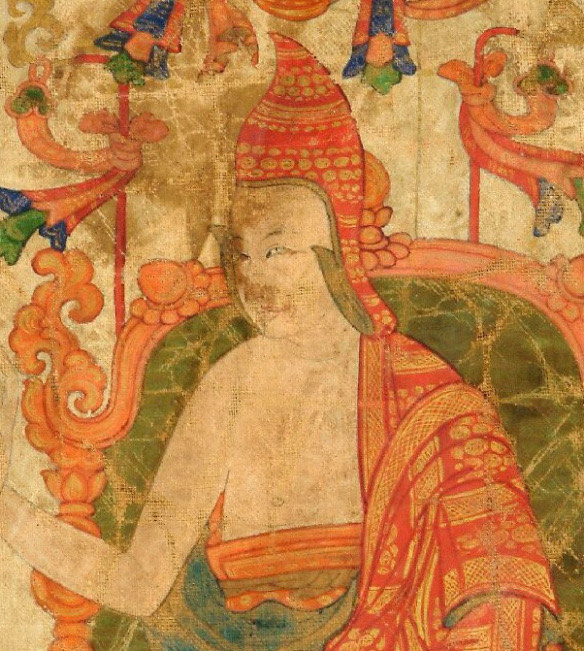
Śāntideva was an Indian Buddhist monk, philosopher and poet. Reliable details of his life are scarce. The Stanford Encyclopedia of Philosophy dates him to the late 7th to mid-8th century, because another Indian author, Śāntarakṣita, quotes him in a text that must have been written by 763 CE.
Tibetan tradition tells a well-known story about him. Traditional accounts say he was a monk at Nālandā who seemed to do nothing but eat and sleep. Some of the monks in authority, hoping to shame him, asked him to recite at a festival and built him an elaborate throne for it. He asked the audience whether they wanted to hear something old or something new, then began the Bodhicaryāvatāra. In the legend he rose into the air while reciting, vanished at verse 9.34, and a voice carried on to the end. SEP cites the account of the Tibetan historian Butön.
Two works are unanimously attributed to him. The Bodhicaryāvatāra (“Entering the Bodhisattva’s Way of Life”) is a poem on awakening the mind of bodhicitta and living by it. The longer version, of about a thousand verses, was the one Tibetans treated as canonical, and it is the one most translated today. Some scholars hold that a shorter version of about seven hundred verses came first. Its opening chapters cover the benefits of bodhicitta, confession, and taking the bodhisattva vow. Patrul Rinpoche wrote a practice guide to the poem, The Brightly Shining Sun.
The second work is the Śikṣā-samuccaya (“Compendium of Training”), an anthology of passages from more than a hundred Mahāyāna sūtras with his comments. It also records daily monastic life and preserves Sanskrit passages from sūtras otherwise lost in that language.
The Bodhicaryāvatāra has been translated into many languages. SEP singles out the Wallace and Wallace translation for precision and the Crosby and Skilton translation for clarity. SEP notes that many Tibetan rituals quote from it or are shaped by it, and the Dalai Lama has called it his favourite religious work.
Read more
Books
A Guide to the Bodhisattva's Way of Life (Bodhicaryāvatāra)
trans. Vesna A. Wallace and B. Alan Wallace · Snow Lion · 1997
The Bodhicaryāvatāra
trans. Kate Crosby and Andrew Skilton · Oxford World's Classics · 1995
The Training Anthology of Śāntideva: A Translation of the Śikṣā-samuccaya
trans. Charles Goodman · Oxford University Press · 2016
Sources and verification
2
Written from published sources by the volunteer editors. Not yet reviewed by an outside advisor.
- ScholarlyStanford Encyclopedia of Philosophy: Śāntideva (dates from Śāntarakṣita's quotation by 763 CE; two works unanimously attributed; longer and shorter versions of the Bodhicaryāvatāra; the Nālandā legend retold from Butön; English translations)
- ArchiveLotsawa House: Śāntideva Series (Bodhicaryāvatāra in the Tengyur, Toh 3871; name variants; Patrul Rinpoche's commentary The Brightly Shining Sun)
Painting: Shantideva, 19th-century painting, artist unknown (Wikimedia Commons, public domain)
Something wrong, missing or out of date? Report a problem. A source we can check makes it quicker to fix.