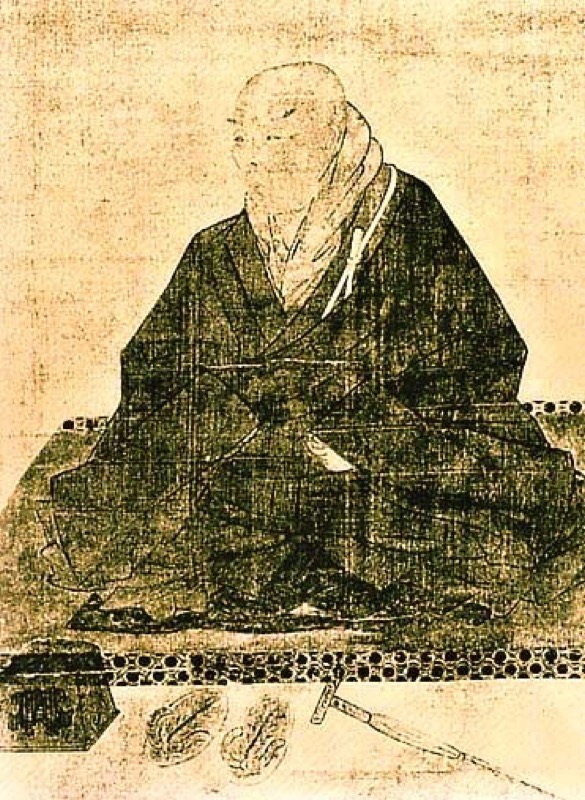
Shinran was born in 1173 into the aristocratic Hino family, at the close of the Heian period. At nine he took the tonsure under the Tendai monk Jien and began studying at the Tendai temple on Mount Hiei. He spent twenty years there. According to the Hongwanji, he came to despair of reaching awakening through such discipline and study.
Hōnen (1133 to 1212) had left Mount Hiei and was teaching a different way: self-generated effort was tainted by attachment, so one should simply say the nembutsu, entrusting oneself wholly to Amida’s Vow to bring all beings to enlightenment. Shinran went to hear him and joined his movement. In 1207 the government banned Hōnen’s teaching and exiled Hōnen and several followers, Shinran among them. Stripped of his priesthood, he was sent to Echigo on the Japan Sea coast. He refused the layman’s name he was given and called himself Toku, “stubble-headed”, neither monk nor layman. He married Eshinni and raised a family.
He was pardoned after five years but did not go back to Kyoto. In 1214 he went to the Kantō region and taught the nembutsu for about twenty years among farmers and lower-ranking samurai. In his sixties he returned to Kyoto and spent his last three decades writing. He completed his major work, usually known as Kyōgyōshinshō, composed hundreds of hymns that made the Chinese scriptures accessible to ordinary people, and wrote letters to followers in the Kantō who disagreed about the teaching.
His central point was that the nembutsu is not a good act one performs. It arises from true entrusting, which he understood as Amida’s working in the person. So the number of times it is said does not matter. He also rejected the idea that Amida’s Vow permits wrongdoing, writing that deep trust brings a genuine awareness of one’s own limitations. The Tannishō is a record of his words and deeds.
He died at ninety. His youngest daughter, Kakushinni, moved his remains in 1272 to a chapel at Yoshimizu in Kyoto, which developed into the Hongwanji.
His writings are available in English at shinranworks.com, in the translation published by the Hongwanji.
Read more
Books
trans. Dennis Hirota (head translator), Hisao Inagaki, Michio Tokunaga and Ryushin Uryuzu · Jōdo Shinshū Hongwanji-ha · 1997
Sources and verification
3
Written from published sources by the volunteer editors. Not yet reviewed by an outside advisor.
- OrganisationJodo Shinshu Hongwanji-ha: Shinran Shonin (dates, Mount Hiei, Honen, exile, Kanto, return to Kyoto, Kyogyoshinsho)
- OrganisationJodo Shinshu Hongwanji-ha: History of the Hongwanji (founded by Shinran, 1173 to 1263; mausoleum and temple origins)
- BookThe Collected Works of Shinran, translated by Dennis Hirota (head translator), Hisao Inagaki, Michio Tokunaga and Ryushin Uryuzu, (c) 1997 Jodo Shinshu Hongwanji-ha
Painting: Portrait of Shinran, medieval Japanese hanging scroll, artist unknown (Wikimedia Commons, public domain)
Something wrong, missing or out of date? Report a problem. A source we can check makes it quicker to fix.