- Kind
- Temple
- Tradition
- Theravada
- Founded
- 1975
- Town
- Krabi
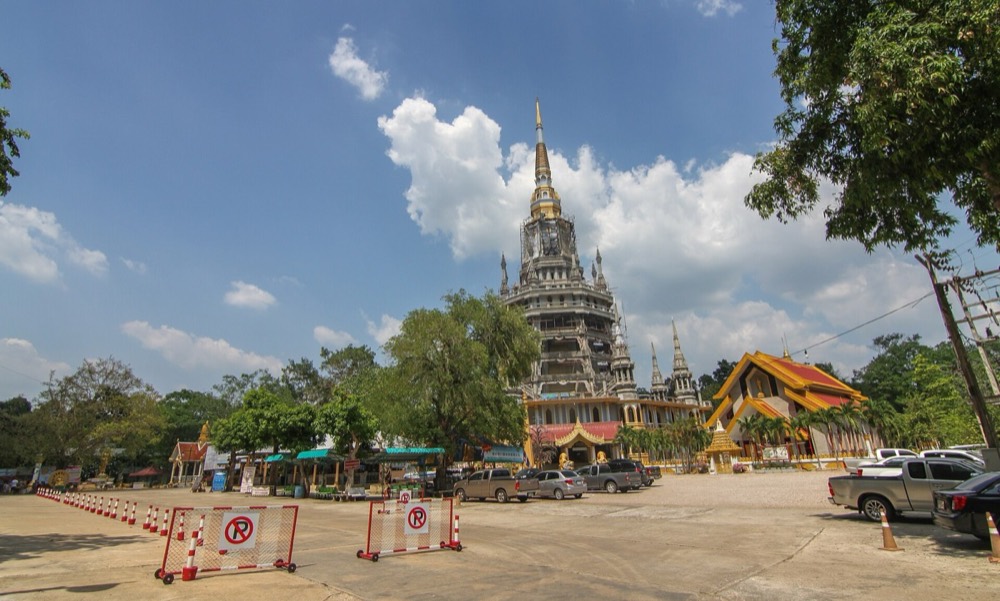
Photo by Maksym Kozlenko (Wikimedia Commons, CC BY-SA 4.0). The chedi and temple grounds
Wat Tham Suea, the Tiger Cave Temple, sits in the hills north-north-east of Krabi town on the Andaman coast. Ajahn Jamnian Silasettho founded it in 1975 as a Vipassana practice centre, first as a small hermitage and from 30 December 1985 as a recognised temple.
Wikipedia gives the usual origin of the name: while meditating in the cave, the founder saw tigers there, and tiger paw prints are shown on the cave walls. Treat it as a local story rather than a record.
Most visitors come for the staircase. The climb to the summit is about 1,260 steps, with a large golden Buddha image at the top and a view over much of Krabi town. Wikipedia notes that monks also live in caves at the foot of the hill, and that the grounds hold a few smaller caves in forest.
The Thai Post reports that Ajahn Jamnian died on 18 August 2026 in Malaysia, and that his body was to be returned to the temple. At that time, according to the Thai Post, Phra Thep Wachirakorn (Phra Ajahn Chai Purinthako), deputy head of the Region 17 Sangha, was acting abbot. Check the temple directly for who holds the post now.
This page cannot say whether the temple currently teaches meditation to foreign visitors. Sources call it a meditation and Vipassana centre, but none of the sources used here describes a course for non-Thai speakers, its length, or how to apply. If you want to practise in southern Thailand, confirm in person or through the temple’s own channels first.
Visiting
A working temple and one of Krabi's busiest sights. Dress modestly, expect a long climb in the heat, and keep food out of sight of the monkeys on the stairs. No meditation programme for foreign visitors could be confirmed from the sources used, so ask at the temple before planning a stay.
Teachers
1
Nearby
within 150 km, straight line
Read more
Sources and verification
3
Written from published sources by the volunteer editors. Not yet reviewed by an outside advisor.
- ReferenceWikipedia: Tiger Cave Temple (location, 1975 founding, staircase, coordinates)
- ReferenceThai Post, 20 August 2026 (founding as a hermitage in 1975, temple status 30 December 1985, current acting abbot)
- ReferenceMerit Messenger, 24 August 2026 (founder's death; repeats the Thai Post)
Something wrong, missing or out of date? Report a problem. A source we can check makes it quicker to fix.